


Australians spend an estimated $350 million on candles each year, yet most of those purchases still contain paraffin wax — a petroleum by-product linked to indoor air quality concerns. When you light a conventional paraffin candle in a closed room, you release a mix of volatile organic compounds, including toluene and benzene, that accumulate in poorly ventilated spaces.
Choosing a sustainable soy candle is not just an aesthetic decision. It is a health, environmental, and long-term value decision. At Gleam Haven, we have spent eight years helping Australian households make the switch with confidence, not guesswork.
This article covers exactly why sustainable soy candles outperform paraffin on health, longevity, and environmental impact — and how to identify one worth buying.
Before You Pick a Candle, Get the Order Right
Most shoppers start with scent or packaging. Starting there leads to disappointment. Work through these three priorities first:
- Be informed: Learn the difference between soy wax, paraffin, and blended waxes so you can read a product label accurately.
- Be confident: Verify that the brand discloses its full wax type, wick material, and fragrance composition before purchase.
- Then shop: Only then look for stockists or online brands that meet your criteria.
A common mistake: a shopper selects a candle for its scent, then discovers the wax is a paraffin-soy blend with undisclosed synthetic fragrance. Starting with ingredient literacy prevents exactly that.
Why Soy Wax Burns Cleaner Than Paraffin
Paraffin is derived from crude oil refining. When burned, it releases petro-carbon soot that coats walls, surfaces, and airways. Soy wax, cold-pressed from soybean oil, burns at a lower temperature and produces significantly less soot. For Australians in smaller apartments or homes with limited ventilation, this distinction matters considerably.
Client example
A Melbourne customer noticed black residue accumulating on her ceiling after six months of burning imported paraffin pillar candles. After switching to Gleam Haven soy candles, residue accumulation stopped entirely within three months.
What to do
- Check wax type on the label; if it reads “wax” without specification, contact the brand directly.
- Look for small-batch pours, which typically use purer base materials with less filler.
- Avoid metal-core wicks, which can release trace lead on combustion.
Not to do: Do not assume “natural fragrance” means the candle is paraffin-free. Fragrance type and wax type are separate disclosures.
Fragrance Without the Synthetic Load

Most mass-market candles use phthalate-based synthetic fragrance to hold scent in wax. Phthalates are endocrine-disrupting chemicals found across personal care and home fragrance products. Gleam Haven uses phthalate-free fragrance oils blended at controlled temperatures to maintain scent integrity without the chemical load. For households with young children, pets, or fragrance sensitivities, this distinction is not a marketing claim — it is a formulation decision.
Client example
A Sydney customer with fragrance-triggered migraines completed full 45-hour burns on our Eucalyptus and White Tea candle with no migraine episodes, compared to weekly episodes with her previous mass-market brand.
What to do
- Prioritise brands that list “phthalate-free fragrance” explicitly on the product page or label.
- Target a fragrance load of 10-12%, which delivers scent without compromising wax structure or burn.
- If you are fragrance-sensitive, start with single-note candles before complex blends.
Not to do: Do not rely on “aromatherapy” labelling as a safety guarantee. The term is unregulated in Australia.
Burn Time, Value for Money, and the True Cost Per Hour
Soy wax burns more slowly and evenly than paraffin due to its lower melting point. A quality 300g soy candle typically delivers 45 to 55 hours of burn time, compared to 30 to 40 hours for an equivalent paraffin candle. Calculated per burn hour, soy consistently delivers equal or better value, particularly on subscription or multi-buy pricing.
Client example
A Brisbane family running four candles per month switched to a Gleam Haven soy subscription and reduced their annual candle spend by 18% without reducing total burn hours, by calculating cost per hour rather than cost per candle.
What to do
- Calculate cost per burn hour, not cost per candle, when comparing products across brands.
- Trim wicks to 5mm before every burn to extend candle life and reduce soot.
- On first burn, allow the melt pool to reach the full jar diameter before extinguishing to prevent tunnelling.
Not to do: Do not judge a soy candle on its first 30 minutes. Full scent throw develops once the melt pool has formed correctly.
Soy vs Paraffin vs Beeswax: Cost and Impact Comparison
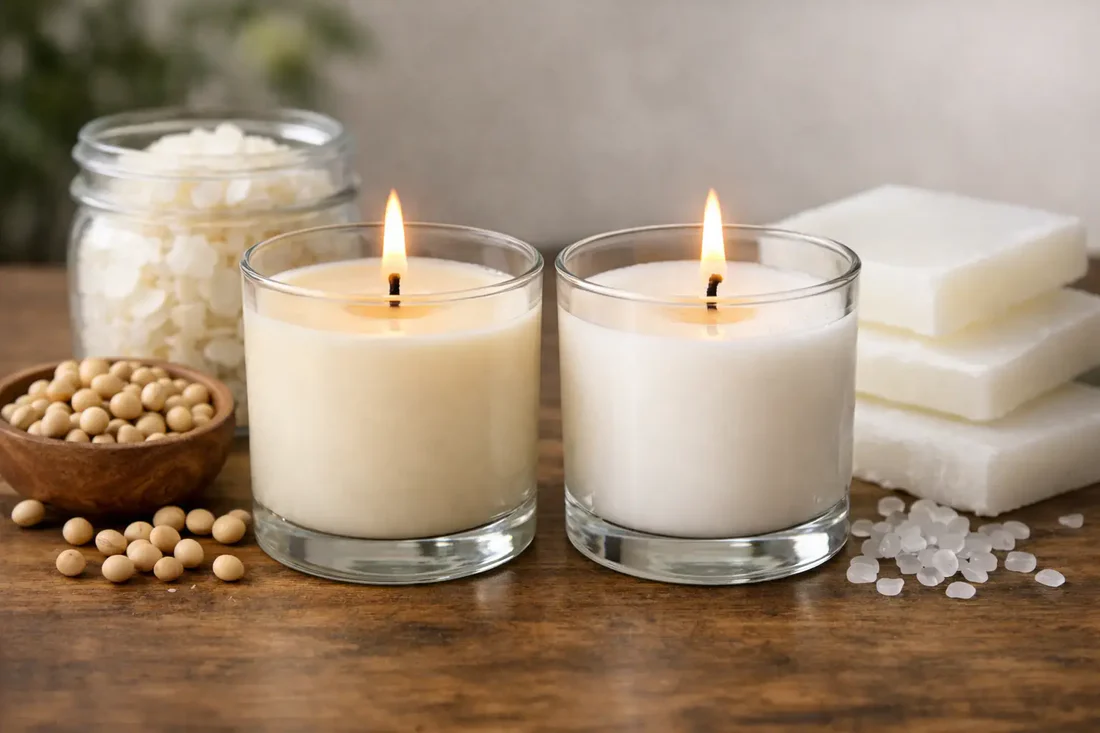
Use this table to compare the three most common candle wax types across the factors that matter most to eco-conscious Australian buyers.
| Feature | Soy Wax | Paraffin | Beeswax |
|---|---|---|---|
| Burn time (300g candle) | 45-55 hours | 30-40 hours | 55-65 hours |
| Cost per burn hour (approx.) | $0.45-$0.60 | $0.55-$0.75 | $0.90-$1.20 |
| Soot output | Low | High | Minimal |
| Renewable source | Yes (soybean oil) | No (crude oil) | Yes (beeswax) |
| Fragrance compatibility | High | High | Low |
| Vegan | Yes | Yes | No |
| Best for | Everyday eco home use | Budget buyers | Allergy-sensitive buyers |
Source: Gleam Haven burn-test data and publicly available wax supplier specifications, 2024.
What We Have Learned Working With Eco-Conscious Australians
After eight years and thousands of orders across Melbourne, Sydney, Brisbane, and beyond, one pattern holds consistently: buyers who research wax type and fragrance transparency before price are more satisfied with their purchase, buy again sooner, and recommend more confidently. The principle is straightforward — ingredient confidence replaces doubt. When you know what is in your candle, every burn is deliberate rather than uncertain. If you want to talk through your options before purchasing, we are always available via the contact page at gleamhaven.au.
Not sure which Gleam Haven candle suits your home? Browse our full soy candle range at gleamhaven.au, where every product lists its full wax, wick, and fragrance composition. Shop Gleam Haven’s eco-friendly soy candle range today.
Frequently Asked Questions
Are soy candles really better for indoor air quality?
Yes. Soy wax burns at a lower temperature and produces significantly less soot than paraffin. Testing has consistently shown that petroleum-derived waxes release higher concentrations of volatile organic compounds when burned. While no candle is entirely emission-free, soy candles represent a meaningful improvement for households concerned about indoor air quality, particularly in smaller or poorly ventilated spaces.
How do I know if a candle is 100% soy and not a blend?
Check the ingredient list on the label. Reputable brands state “100% soy wax” explicitly. If the label reads “soy wax blend,” “natural wax,” or simply “wax,” the product likely contains paraffin or filler waxes. Request a technical data sheet directly from the brand if you need written confirmation of wax composition before purchasing.
Do soy candles have a weaker scent throw than paraffin?
Not when formulated correctly. Soy wax holds fragrance oil effectively when the correct fragrance load and pour temperature are used. Weak scent throw in soy candles reflects a manufacturing issue, not an inherent property of the wax. Well-made soy candles deliver consistent cold and hot throw across their full burn life.
Are Australian-made soy candles more sustainable than imported ones?
Generally yes. Locally produced candles carry significantly lower transport emissions, are more likely to use domestically sourced or responsibly certified soy, and typically use recyclable packaging suited to Australian recycling streams. Gleam Haven candles are made in Australia and shipped in recycled and recyclable materials.
I have a dog at home. Are soy candles safe around pets?
Soy wax itself is non-toxic to most pets, but some fragrance oils can be problematic for dogs and cats that are sensitive to essential oils. Choose candles with lower fragrance loads and avoid burning in confined spaces with animals present. Gleam Haven’s Unscented Soy range is specifically formulated for households with pets or fragrance-sensitive occupants.
Can I use soy candles in a humid Queensland climate?
Yes, though high humidity can cause natural “frosting” on the wax surface. This is a cosmetic characteristic of soy wax and does not affect burn quality or scent performance. Store candles away from direct sunlight and allow them to reach room temperature before burning, particularly if moving between a heavily air-conditioned space and a warm room.
About the Author
Gleam Haven, is an Australian brand based in Melbourne. With more than eight years of experience in clean home fragrance formulation, Sarah works with eco-conscious households and boutique retailers across Australia to provide transparently formulated, phthalate-free soy candles. Gleam Haven has been featured in Australian sustainable living publications including Eco Collective and The Green Edit. Learn more at gleamhaven.au.